For REMLOs · REALTOR® and loan officer, one seat
Sell the house. Write the loan. One screen, one client.
You hold both licenses. Smooth Flow treats you as one person: every buyer carries the house dates and the loan steps side by side, the investors who need financing are named, and the RESPA/Reg-Z two-hat file builds itself while you work. Lender-neutral: your lender, your economics, no cut of your loan.
No live rate ever shows to a client, by rule. You approve every send.

What the second license adds
One buyer. Both clocks.
The loan side lives inside the same screens you already work: the deal, the Morning, the investor. Nothing to type twice.
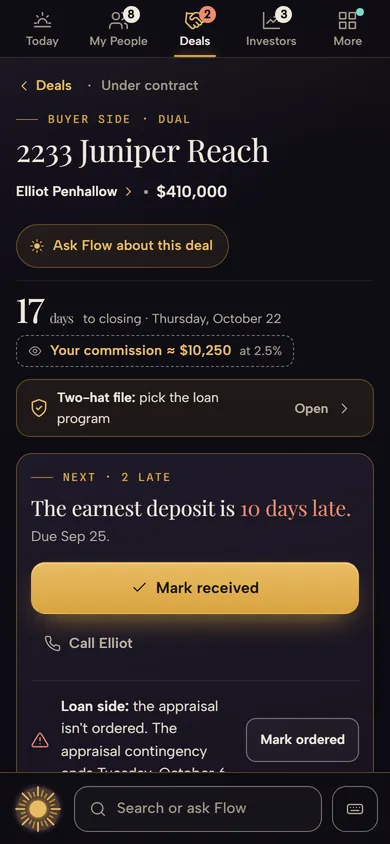
The house and the loan, side by side.
Every deal page splits in two: the contract dates on one side, the loan steps on the other, each with its day and red only when it is late. The thing that is late sits on top with its button.

Your loans, in plain words.
The Loans board reads like a sentence: “Elliot: appraisal not ordered, contingency tomorrow.” One row per buyer with the home clock and the loan clock, red first, then your refi windows and the investors who need financing, by name.

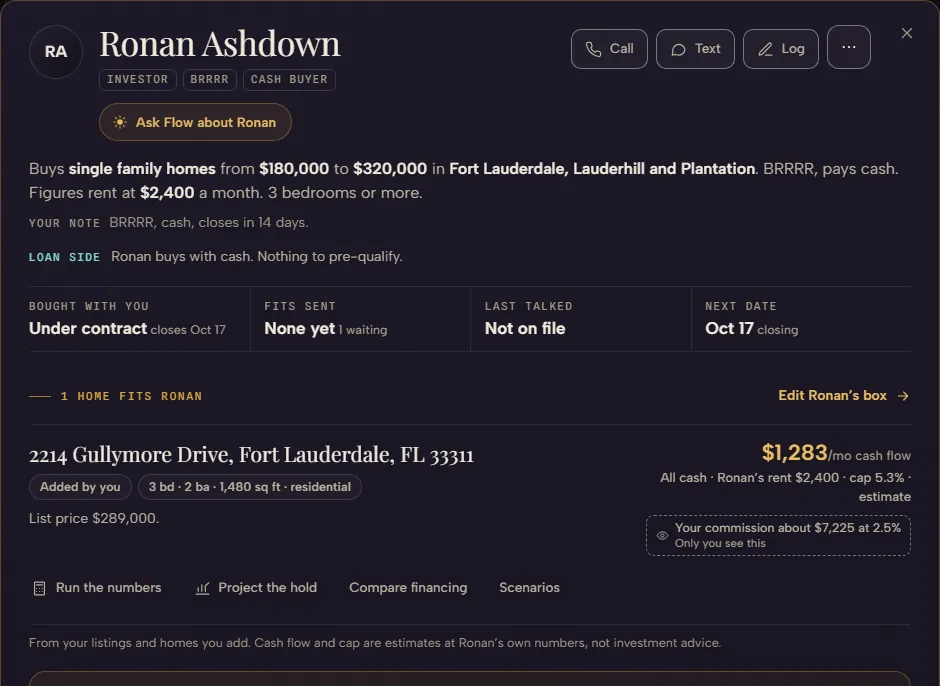
Your investor asks how to pay for it.
On a dual seat every investor’s page names the loan side in words, and Compare financing and Scenarios open beside each home that fits, filled in at the investor’s own numbers, on your screen.
Cash flow and cap rate are estimates at the investor’s own numbers, not investment advice.
The compliance side
Do both jobs. Keep the receipts.
The second license comes with a second set of rules. Below is the firewall the app runs, live on your phone: pick the program on the deal in your head.
You are standing in a deal right now. Which one?
Pick the loan program on the file in your head. The firewall answers the way the app answers it, on your phone, and the desk deals what fires at your stage of that deal.
This verdict was computed on your phone. Nothing you tapped left it.
Five doors. One firewall. It answers before the examiner asks.
See it run live on a sample deal →That one is not in here. Try another word, or ask it at your walkthrough.
Your binder, so far
Stamped from your device clock. The only lines here are the doors you ran.
Compliance tooling, not legal advice. Rules verified federal and Florida.
Most REMLOs don't know FHA opened the door in 2022, and USDA slammed it shut.
The dual-compensation rules changed, they differ by loan program, and they are exactly the kind of thing an examiner asks about years later. The app carries the verdict logic (Conventional yes, FHA verify per HUD's 2022 letter, USDA blocked) and tells you which door you're standing in on the file you're working, with the paperwork stamped as you go. Verified federal + Florida; everywhere else it tells you, in those words, to verify with your regulator.
The rules changed on a date. Your file either shows it or it does not.
Live, never recorded
The Two-Hat Demo
One synthetic FHA file, run through the real compliance engine while you watch.
- 1The firewall verdict. Which door you are standing in, on this file, in words you can repeat to your broker.
- 2The AfBA disclosure. Stamped and dated as you go, not reconstructed a year later.
- 3One update. The house side and the loan side move together, because it is one buyer.
- 4The exam binder. Already written, because you worked.
There is no recording of this demo. A recording would show you our file. Live, it runs on the kind of deal you actually work, and you can stop us anywhere and ask the question you came with. Four beats, and it happens at your walkthrough, nowhere else.
Book your walkthrough →The two-CRM life, retired.
Today
- A real-estate CRM that has never heard of the loan.
- A mortgage CRM that thinks you're two different people.
- The same buyer typed twice; the same update sent twice.
- Deadlines that can collide, rate lock vs. inspection window, with nothing watching both.
- The compliance story lives in your memory, assembled the week an auditor asks.
A dual-licensed agent pays for two CRMs that never talk today. Neither writes the compliance file, and neither reads your book at night.
On Smooth Flow
- One buyer record carrying the house timeline and the loan timeline together.
- One update writes to both sides; collisions get flagged before they cost you.
- Disclosures generated at the moment the rule requires them, logged as they happen.
- The services log and exam binder build themselves as a by-product of the work.
- Your lender stays your lender. Nobody routes your loan or takes a basis point.
The file writes itself. Here's the shape of it.
The firewall verdict
Before the two hats touch a file together, the app runs the program rules and hands you the verdict: proceed, verify, or blocked, with the citation attached.
The disclosure, on time
The AfBA disclosure generates when the relationship requires it, not when someone remembers. Signed, stamped, filed.
One update, both timelines
Tell the buyer once. The house side and the loan side both record it, and the services log grows a line you never had to write.
The exam binder
The day someone official asks, the answer is a bound, dated record of what happened and when, built while you worked, not the weekend before.
"Proprietary AI that sees both the home and the loan on the same buyer, and bakes in the RESPA / Reg-Z two-hat compliance guardrails, federal + Florida verified. Compliance tooling, not legal advice."
The claim, exactly as we'll defend it
And the whole agent seat underneath.
The dual-license layer sits on everything the agent seat gets: the Morning, the drafted replies, the investor tools, listings and the Studio, the field guide.
Overnight, replies to the leads who wrote in are staged in your voice, waiting for your OK.
Your whole book in one sentence, your money in three figures from your records, and the next thing on top with its button.
The AI composes; only you can send. The exceptions are opt-in lanes you switch on yourself.
No live rate ever shows to a client, by rule. Educational content only, with your NMLS footer where it belongs.
Standing buy boxes match your listings, owner leads and county sales against your investors’ criteria, with cash flow as an estimate at their numbers and 1031 clocks, all on your license.
A narrated field guide and short how-to videos. They come with the seat.
Founding seats are open. There are fifty.
Live, on a sample file, firewall to binder. You leave with the shape of your file and your founding price.
Book a founding walkthrough